
Household Hazardous Waste Acceptance Site
Effective April 15, 2024, due to ongoing construction, the Household Hazardous Waste (HHW) and other associated lots will be closed to the public. Residents can properly dispose of HHW items at upcoming mobile events.
Mobile Disposal Events
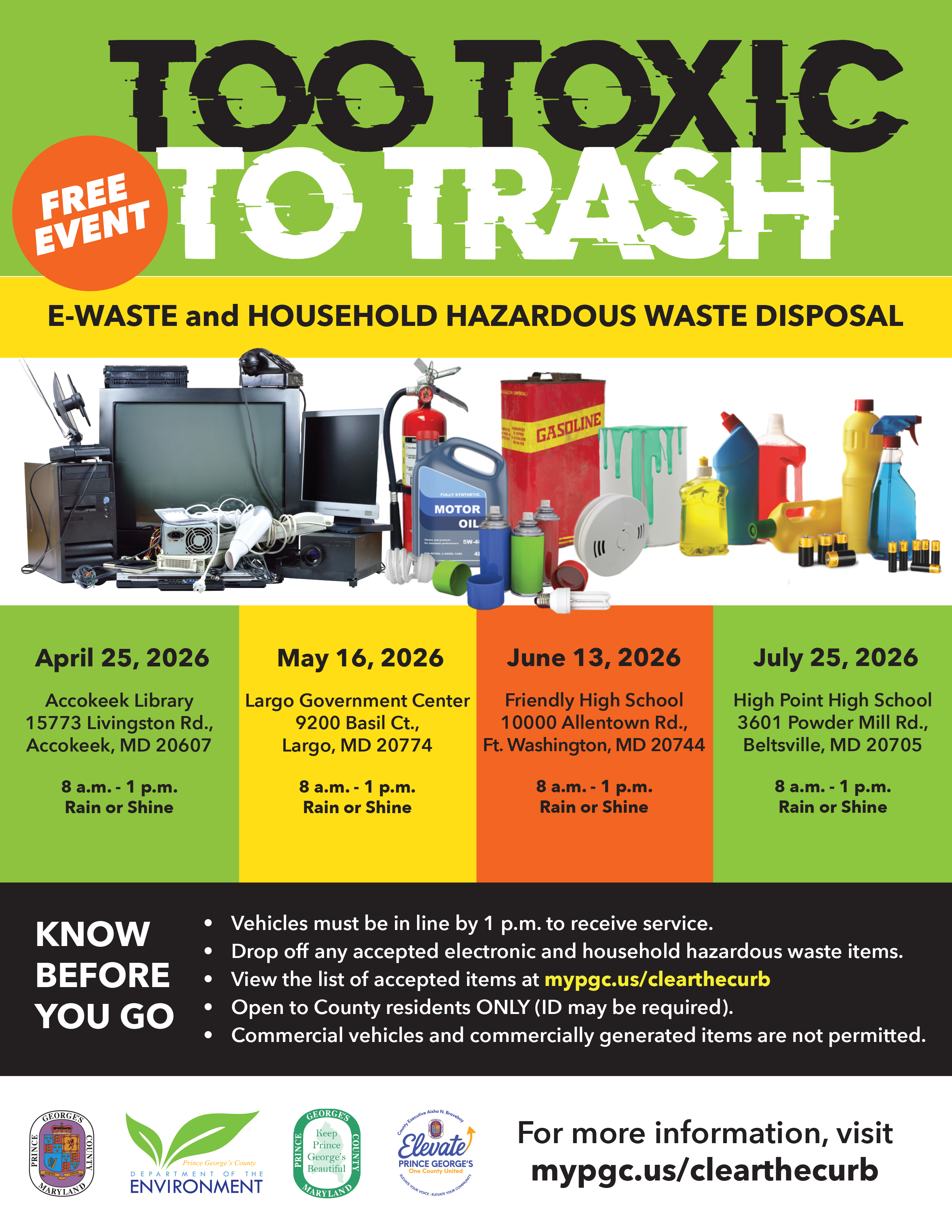
Household Hazardous Waste (HHW) and Electronics Recycling (E-waste) can be properly disposed of at County-hosted mobile events from 8 a.m. to 1 p.m.
Too Toxic To Trash - English l Too Toxic To Trash - Español
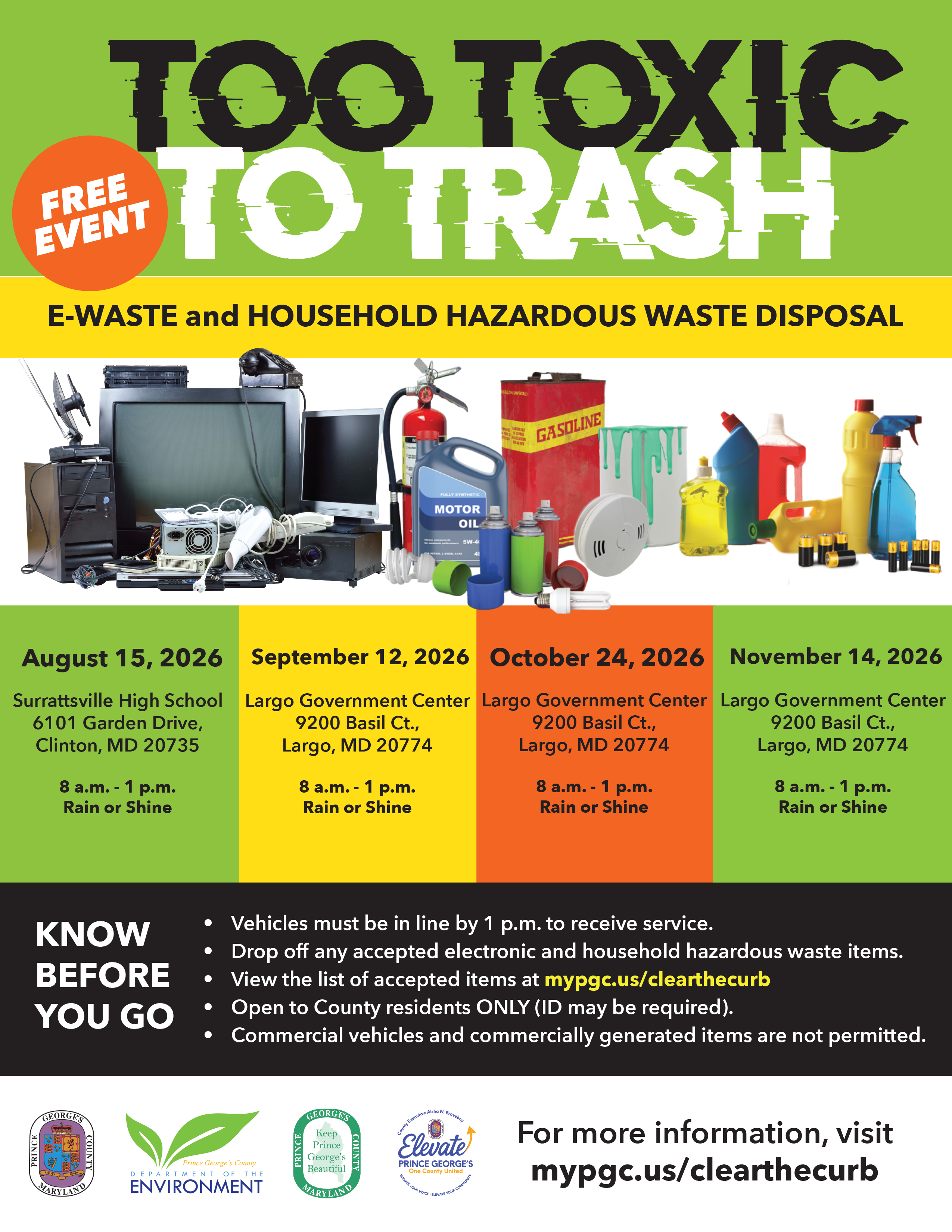
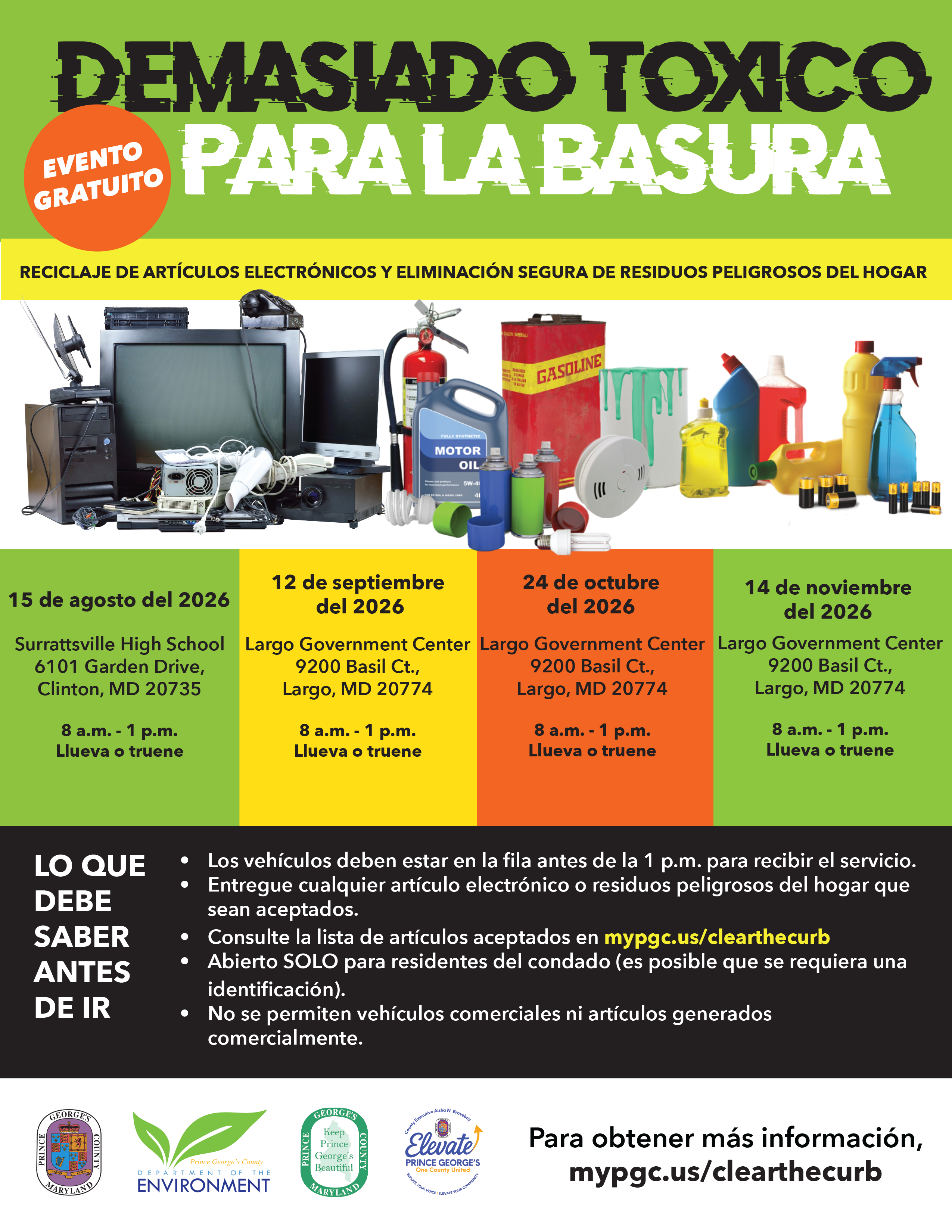
| Acceptable Electronics: | Acceptable HHW: |
|---|---|
| Any individual PC CPU component parts Cable CD Players Cell Phones Circuit Boards Computer Monitors Computer Speakers Copiers CPUs Fax Machines Ink Jet and Toner Cartridges (from printers and fax machines) Keyboards Laptop Computers Main Frames Mice Pagers Printers Radios/Stereos Scanners Surge Protectors Telephone System Televisions (flat and console/tube/CRT) VCRs Wire |
Acid Car Batteries
|
Non-Commercial Vehicles Only
Prince George’s County opened the Household Hazardous Waste (HHW) Acceptance Site in the spring of 2000. The site and other associated lots at the Brown Station Road Sanitary Landfill, 11611 White House Road in Upper Marlboro, have been closed to the public. Residents can properly dispose of household hazardous waste (HHW) and electronic waste (e-waste) items at upcoming mobile events. Residents can temporarily take Electronics to the Brown Station Road Convenience Center, 3501 Brown Station Road, Upper Marlboro, for proper disposal.
Improper disposal of these materials is harmful to the environment:
| Acid Car Batteries | Gas Grill Propane Tanks | Photographic Chemicals |
|---|---|---|
| Automotive Fluids and Fuels | Helium Balloon Tanks | Poisons |
| Cleaning Agents | Household Batteries | Smoke Detectors |
| Cooking Oil | Insecticides, Herbicides, and Fertilizers | Solvents, Varnishes, and Stains |
| Driveway Sealers | Kerosene (up to 5 gallons) | Swimming Pool Chemicals |
| Fire Extinguishers | Mercury and Other Hazardous Materials | |
| Fluorescent Light Bulbs | Paints (latex and oil-based) |
Hazardous Waste Disposal Contract
The County has contracted with a licensed hazardous waste disposal company to ensure the proper handling and disposal of the hazardous materials collected at the Household Hazardous Waste (HHW) Acceptance Site. The professional team oversees the collection of items and materials at the drop-off facility and the community collection events.
County residents do not have to leave their vehicles to dispose of unwanted items. A licensed hazardous materials company professional will remove all acceptable items from your vehicle and dispose of them safely and in an environmentally responsible manner.
Collection for Senior Citizens & the Disabled
As of June 2022, at-home household hazardous waste collection is no longer available. Individuals may participate in upcoming mobile events or hire a licensed HHW vendor to pick up and dispose of items at a licensed facility.
Handling and Proper Disposal of Asbestos
With every asbestos exposure, the risk of developing asbestos-related diseases such as mesothelioma cancer, lung cancer, and asbestosis increases. To ensure proper handling and disposal of asbestos, we encourage you to visit the Asbestos website to learn why it is important to handle asbestos safely.
Paints (latex and oil-based)
Beginning April 1st, 2026, PaintCare will offer drop-off sites throughout Maryland where the public can drop off unwanted paint for recycling. These sites are available to households, businesses, government agencies, and others with leftover paint. For more information, please visit: https://www.paintcare.org/states/maryland/
Also, residents can now drop off leftover paint (latex and oil-based) at the Household Hazardous Waste (HHW) Acceptance Site* for proper disposal during operating hours. However, to reduce waste, residents are strongly encouraged to donate usable paint to relatives, friends, neighbors, or local community groups who might need it for a project.
*Due to ongoing construction, Household Hazardous Waste (HHW) and Electronics Recycling (E-waste) can be properly disposed of at County-hosted mobile events from 8 a.m. to 1 p.m.
Too Toxic To Trash - English l Too Toxic To Trash - Español
Propane Tanks
Extreme care should be observed when disposing of old propane tanks. Even when seemingly empty, they still contain flammable gas, which could cause an explosion. Some important handling tips:
- Do not attempt to remove the valve from the tank.
- Do not leave the valve open, as the escaping gas is a fire hazard.
- Transport cylinders in a secure and upright position.
Tanks/cylinders must not be mixed with scrap metal at the convenience centers or the collection lot in the landfill. There is a dedicated area for propane tanks at the site, where they are accepted and managed separately. When disposing of materials, please inform staff if propane tanks are present so they can be tagged and secured for your safety and the attendants'.
Safe and proper disposal is vital to the environment!
For questions, please call 301-952-7625.
Used Motor Oil and Antifreeze
Used motor oil may be disposed of at the Brown Station Road Convenience Center and the Household Hazardous Waste (HHW) Acceptance Site, located at the Landfill, during posted location hours.
County residents may safely dispose of UP TO 3 gallons per visit of used motor oil and antifreeze at:
Brown Station Road Convenience Center
3501 Brown Station Road
Upper Marlboro, MD 20772
Hours:
Monday - Friday: 7 a.m. - 6 p.m.
Saturday: 7 a.m. - 6 p.m.
Sunday: Closed
Missouri Avenue Convenience Center
12701 Missouri Avenue
Brandywine, MD 20613
Hours:
Monday, Wednesday, and Friday: 6:30 a.m. — 3 p.m.
Tuesday and Thursday: 10 a.m. — 6:30 p.m.
Saturday: 7:30 a.m. — 4 p.m.
Sunday: Closed
Batteries
Battery Safe - English l Battery Safe - Español
Stay Battery SAFE - Never place batteries in your regular trash or recycling. Auto parts stores offer customers a "battery core" credit toward a compost container. Even "dead" batteries can still spark fires if damaged or crushed. Household batteries — including alkaline and rechargeable batteries — cannot be landfilled, recycled, or composted because they contain harmful materials such as mercury, lead, cadmium, and nickel.
Incorrect battery disposal can cause high-risk fires during transportation and at County facilities. Dead batteries are not completely dead and must be stored and disposed of properly to prevent fires. Batteries must be recycled or dropped off at a designated facility.
Two Basic Types of Batteries
Rechargeable batteries are electrical batteries that can be charged, discharged, and recharged many times. Rechargeable batteries are used in laptops, tablets, digital cameras, cell phones, watches, cordless power tools, and electric vehicles, including car batteries. They are typically lithium-ion, nickel-cadmium, nickel-metal hydride, nickel-zinc, or sealed lead-acid batteries.
Single-use or disposable: Alkaline batteries are the common household types found in remote control devices, clocks, flashlights, toys, smoke detectors, and other wireless devices. Although they are usually non-hazardous, treating alkaline batteries as hazardous waste is safer.
Proper Storage and Disposal of Batteries
ALL batteries:
- To prevent fire risks, put a little tape over the terminals (the ends of the batteries) until you are ready to dispose of them.
- After taping, collect used batteries in a container that won't spark, such as a cardboard box or a rigid plastic container (e.g., a bucket, juice container, detergent bottle). Auto parts stores offer customers a "battery core" credit toward a purchase.
- Do not store different types of batteries together. If you have multiple types of batteries, collect and store them by type.
- Take or mail back batteries to a proper acceptance facility.
- Check the EPA website for Electronics Donation and Recycling businesses at www.epa.gov/recycle/electronics-donation-and-recycling.
| Car Batteries | Rechargeable & Single-Use/Disposable Batteries |
|---|---|
| ✔ Accepted at the HHW Acceptance Site | ✔ Accepted at the HHW Acceptance Site |
| Check with auto parts retailers in your area. Most stores that sell auto parts will offer customers a "battery core" credit towards a new battery, which can save you money. |
Check with local electronics and hardware retailer in your area. |
View a video on the proper disposal of batteries
Safe Battery Disposal - English | Safe Battery Disposal - Español
Proper Disposal of Compact Fluorescent Light Bulbs (CFLs)
CFLs are being used in more homes and businesses than ever before. By using CFLs, consumers can save money and energy by reducing energy consumption and lowering utility bills. CFLs contain a minimal amount of mercury within the tubing - an average of 5 milligrams - and are safe to use in your home. However, the bulbs should be handled with care. Precautions should be taken when handling broken CFLs and disposing of used fluorescent lamps properly.
Proper Disposal of CFLs
- Do not throw CFLs away in your household garbage.
- CFLs are accepted at the HHW Acceptance Site.
- Consumers should check local hardware retailers, like Home Depot, to ensure they accept used and unbroken CFL bulbs. An environmental management company will recycle the bulbs to maximize safety and ensure compliance with environmental regulations.
Proper Clean-up for Broken CFLs
- Open a window and leave the room for at least 15 minutes.
- On hard surfaces, carefully scoop up broken glass pieces and powder using stiff paper or cardboard, then place them in a sealed plastic bag. Do not use a vacuum or broom to clean up the broken bulb. Use sticky tape, such as duct tape, to pick up any remaining small glass fragments and powder. Wipe the area clean with damp paper towels or disposable wet wipes. Place the towels in a plastic bag.
- On carpeting or rugs, carefully pick up glass fragments and place them in a sealed plastic bag. Use sticky tape, such as duct tape, to pick up any remaining small glass fragments and powder. If vacuuming is needed after removing all visible materials, vacuum the area where the bulb was broken and place the vacuum bag and debris in a sealed plastic bag.
- Take the plastic bags to the HHW Acceptance site for proper and safe disposal.
Smoke Detectors
Most smoke detectors have a minimal amount of Americium 241, which is radioactive (requiring landfilling at a low-level radioactive landfill).
Options for proper disposal include returning smoke detectors to manufacturers, as many accept their products back for proper disposal.
Smoke detectors are also accepted at the HHW Acceptance Site during operating hours.
Medical Waste
Always keep medications and medical waste out of reach of children and pets.
Never loosely dispose of medical waste, such as needles and syringes, in your regular trash, recycling, and yard trim containers, or leave items lying around your house.
What are sharps?
“Sharps” describe medical devices with sharp points or edges that can puncture or cut skin, such as needles, syringes, infusion sets, lancets, Continuous Glucose Monitoring (CGM) applicators, and auto-injectors. Used sharps are hazardous and should never be thrown loosely into the trash or toilet.
Sharps may be stored in a durable container for later disposal. Your physician may prescribe a medically safe disposal container.
Proper disposal of sharps:
- Immediately after use, place the sharps needle end first into a rigid plastic container with a cap or screw-on lid.
- Label the container "SHARPS" to prevent the hazardous waste from being recycled.
- When nearly full, seal and tape the lid in place with heavy-duty tape.
- Dispose of your sealed "SHARPS" container in your regular trash.
Disposal alternatives:
- Consider a needle destruction device that cuts or heats the used needle immediately after use.
- Clipped needles should be disposed of in the same manner as all sharps.
- Take used syringes to a medical facility that accepts them.
- Utilize a mail-back program, like www.sharpsassure.com.
- Register for an exchange program that accepts used syringes for replacement with clean ones.
Search for local disposal options at www.safeneedledisposal.org.
Visit the FDA's website for information on used needles and sharps disposal.
Prescription Drugs/Medication Disposal
- Take unused, unneeded, or expired prescription drugs out of their original prescription bottles or remove the label (to protect your personal information).
- Crush and mix pills, capsules, and liquids with an inedible substance, such as dirt, cat litter, or used coffee grounds.
- Place the mixture in a container such as a sealed plastic bag or a prescription bottle without personal information or a label.
- Dispose of the container with the mixture in your regular household trash.
- Recycle the empty prescription bottle if you use another container.
Unless specifically noted, do not throw prescriptions down the toilet or drain.
Watch our video - Trash or Recycling in PGC: Prescription Bottles and Medication.
Visit the FDA's website for more tips on proper medication disposal.
View the list of acceptable items at the Electronics Recycling Acceptance Site here.
-
11611 White House Road
Upper Marlboro, MD 20772
United States
Hours
8 a.m. - 3:30 p.m.
Sun - Wed
Closed